








Hook and loop is a two-part fastening system made from a rough hook side and a soft loop side. When the two sides are pressed together, the hooks catch in the loops to create a strong, reusable closure. The product is often called VELCRO®, but VELCRO® is a brand name; the general product name is hook and loop.
This guide explains how hook and loop works, where the idea came from, which product formats are available, and how to choose between sew-on, peel-and-stick, straps, coins, wide loop, and specialty fasteners.
What Is a Hook and Loop Closure?
A hook and loop closure is a reusable fastener made from two matching sides. The hook side is rough and scratchy, while the loop side is soft and fuzzy. When the hook side is pressed into the loop side, the two pieces bond together and can be pulled apart and reused.
Hook and loop works best when the hook side is paired with the correct loop side. The hook side can stick to many soft or fibrous surfaces, but the strongest and most reliable closure comes from a matched hook and loop pair.
Hook and Loop vs. VELCRO® Brand Fasteners
Hook and loop is the product category. VELCRO® is the company and brand name associated with the original fastener. Many people use “Velcro” as a general term, but the accurate product name is hook and loop.
The original VELCRO® Brand patent expired in 1978, which allowed other companies to produce hook and loop products. Today, hook and loop fasteners are available under multiple brand names, including VELCRO® Brand and DuraGrip® Brand.
How Hook and Loop Was Invented
George de Mestral developed the idea for hook and loop in the 1940s after studying burrs that stuck to his clothing during a hunting trip. He noticed that the burrs used tiny hooks to latch onto loops in fabric and other surfaces.
De Mestral imagined a reusable fastener made from two pieces of material: one with hooks and one with loops. He tested cotton fibers before choosing nylon because it did not degrade as quickly and could be made in different thread thicknesses. After many trials and the development of a mechanized production method, he received a patent in 1955 and began production under the VELCRO® Brand.
The name VELCRO® comes from the French words velours, meaning velvet, and crochet, meaning hook.
Common Hook and Loop Product Types
Hook and loop material is available in several formats for different fastening needs. Some products prioritize grip strength, while others balance holding power with repeated use, also known as cycle life.
| Product Type | Best Fit Based on Existing Page Content |
|---|---|
| Continuous rolls | Useful when hook and loop needs to be cut to length for a project or application. |
| Coins and dots | Round hook and loop pieces used where small fastening points are needed. |
| By-the-yard material | Useful for larger projects, including wide loop applications. |
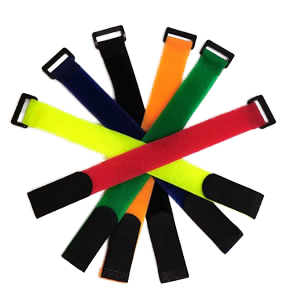
| Straps | Used for bundling, securing, wrapping, or adjustable fastening. |
| Specialty fasteners | Used when a standard hook and loop closure does not meet the application requirements. |
Peel-and-Stick Hook and Loop
Peel-and-stick hook and loop, also called adhesive-backed hook and loop, has a pressure-sensitive adhesive backing. It is useful in applications where sewing is not ideal or possible.
Adhesive-backed hook and loop is commonly available with rubber-based or acrylic-based adhesives. These adhesives can vary in bonding strength, surface compatibility, and performance in different temperature and humidity conditions. A product that works well indoors may not be the best choice for outdoor use.
Hook and Loop Sandpaper
Hook and loop sandpaper uses the same fastening principle as other hook and loop products. The sanding disc has a loop backing that attaches to a hook-faced sanding pad on a power tool.
This setup lets users switch between sandpaper grits without adhesives or tools. The bond is strong enough for high-speed sanding but can still be removed or repositioned. Hook and loop sandpaper is commonly used in automotive, woodworking, and metalworking applications.
Hook and Loop Patches
A hook loop patch is a badge, label, or insignia that uses hook and loop backing for easy attachment and removal. These patches are often used on military, tactical, and service uniforms.
In a typical patch setup, one side of the fastener is sewn onto the garment and the matching side is attached to the patch. This allows patches to be removed or replaced without damaging the fabric, making them useful for personalization, names, logos, and role-specific identification.
Specialty Hook and Loop Fasteners
Some applications require specialty hook and loop systems rather than a basic closure. Existing examples include flame-retardant, flexible, and self-wrapping products.
- VELCRO® Brand HI-GARDE®: A flame-retardant fastener designed for first responder gear and listed on the current page as withstanding temperatures up to 800°F.
- VELCRO® Brand VELSTRETCH®: A flexible loop material suited for orthopaedics and adjustable wearables.
- VELCRO® Brand ONE-WRAP®: A self-wrapping product with hook on one side and loop on the other, commonly used for organizing cables.
Common Uses for Hook and Loop Fasteners
Hook and loop fasteners are used across many industries because they are reusable, adjustable, and available in multiple formats, colors, widths, and grip strengths.
- Military: Used in uniforms, gear patches, and load-bearing equipment.
- Aerospace: Used by NASA in modified form to anchor tools and instruments in zero gravity.
- Automotive and marine: Used to secure removable panels, mats, and upholstery.
- Education and crafts: Used by teachers and artists for interactive displays, decorations, and sorting tasks.
- Home, sports, and industrial applications: Used in applications such as pet collars, sports gear, and industrial equipment.
How to Choose the Right Hook and Loop Product
Start by choosing the format that fits the way the fastener will be used. Sew-on products are useful when stitching is appropriate. Peel-and-stick products are useful when sewing is not ideal. Straps, coins, wide loop, cable ties, and specialty fasteners solve more specific fastening needs.
| Need | Product Direction |
|---|---|
| General fastening by the roll | Shop hook and loop products |
| No-sew attachment | Use peel-and-stick hook and loop |
| Larger loop surface | Consider wide loop |
| Cable bundling or self-wrapping | Use ONE-WRAP® cable ties |
| Special application requirements | Review specialty fasteners or contact HookandLoop.com for product guidance. |
Hook and loop is a simple fastening idea with a wide range of uses. By matching the hook side, loop side, adhesive or sew-on format, and product style to the application, buyers can choose a reusable closure that fits the job.
FAQ:
Q. What is hook and loop?
A. Hook and loop is a two-part fastener made from a rough hook side and a soft loop side. When the two sides are pressed together, the hooks catch in the loops to create a reusable closure.
Q. Is hook and loop the same as VELCRO®?
A. Hook and loop is the product category. VELCRO® is a brand name associated with the original fastener.
Q. What is the scratchy side of hook and loop called?
A. The scratchy side is called the hook side. The soft, fuzzy side is called the loop side.
Q. What is peel-and-stick hook and loop?
A. Peel-and-stick hook and loop is adhesive-backed hook and loop. It is used where sewing is not ideal or possible, and adhesive performance can vary by surface, temperature, and humidity conditions.
Q. What is hook and loop used for?
A. Hook and loop is used for closures, straps, patches, sanding discs, cable organization, removable panels, education and craft projects, uniforms, gear, and many industrial applications.